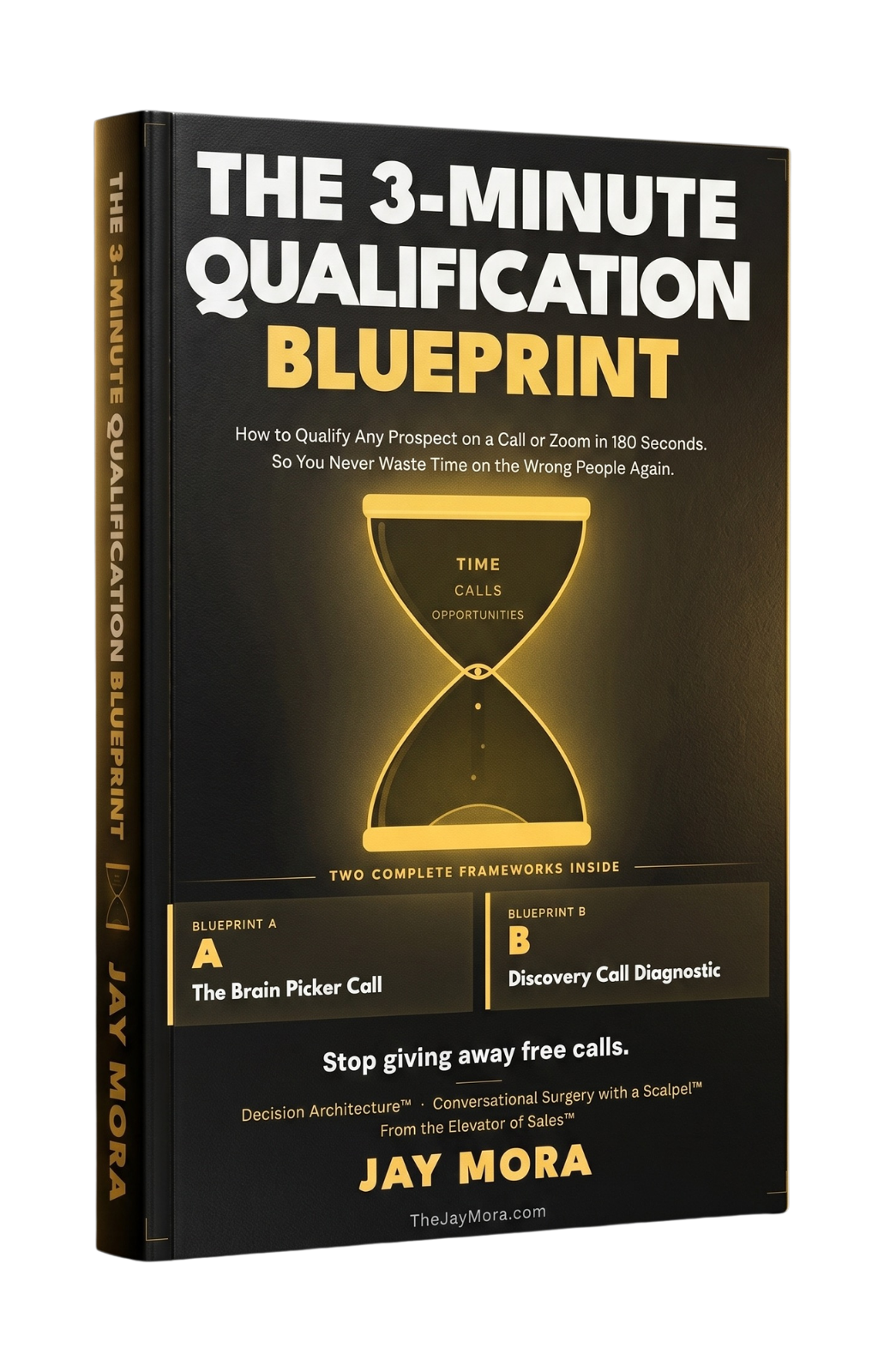
The 3-Minute Qualification Blueprint
For coaches, consultants, agency owners, and founder-led service providers who are done wasting discovery calls on people who were never going to invest.
Free. No cost. Delivered when you complete the Revenue Leak Calculator.
Get the Blueprint Free →The Call That Should Not Have Happened
Most revenue does not leak from a broken funnel. It leaks from the inside of a conversation that never should have started.
You finish the call. You shared everything you had. You diagnosed the problem clearly, outlined the path forward with precision, and gave the person sitting across from you enough insight to move. They thanked you. They said it was exactly what they needed. Then they sent you a message two days later: "Still processing everything. Will circle back."
They do not circle back.
The error did not happen at the end of the call. It did not happen when they objected or when they said they needed to think about it. It happened in the first three minutes, before you had enough information to decide whether the conversation was worth having at all. The absence of a filter at the front of the call is the entire problem. Not the offer. Not the price. Not the funnel.
The average unqualified call does not cost you one hour. It costs you the hour, the mental residue that follows, and the next qualified prospect who could have occupied that space instead.
Most experts know they are giving too much away. They feel it midway through the call. The problem is not awareness. The problem is the absence of a structure that allows them to stop without it feeling abrupt or rude. The Five-Gate Filter is that structure. It does not require you to become someone different. It requires you to run five gates before the conversation earns the right to go deep.
What the Blueprint Contains
The blueprint is not a script. It is not a persuasion system. It is a qualification filter: a structured sequence for determining, before the conversation goes deep, whether the person across from you belongs in it at all. Two frameworks. One filter. Both run through the same five gates.
For unsolicited requests, cold inbound messages, and referrals that skipped any intake process. The framework for qualifying the call before the call starts. A prospect who has not self-selected through any mechanism requires a different opening than one who booked through your calendar.
For booked, inbound discovery calls. The structured qualification sequence for someone who has already self-selected through your calendar. Assumes prior context. Moves faster. The prospect has already demonstrated some level of intent. This framework builds on that without squandering it.
Both frameworks run through the same Five-Gate Filter. The opening of each is different because the starting context is different. A prospect who arrives via an unsolicited message has not made any prior commitment. A prospect who booked through your intake process has already cleared at least two gates before the call begins. The framework accounts for both scenarios without conflating them.
The Five Gates
The Five-Gate Filter™ is the qualification sequence at the center of both frameworks. Five gates. One order. A prospect who does not pass all five does not receive the full enrollment conversation. Not as a rejection. As a redirect. The gates protect both parties from a conversation that cannot produce a mutual outcome.
Gate 1Money
The first gate and the one most experts avoid. Asking about financial readiness is not presumptuous. It is the first act of respect in the conversation. A prospect who cannot invest at your level does not become more qualified by the time you reach the close. Gate one surfaces this in the first sixty seconds. Skipping it in the name of comfort is the most common reason a forty-five-minute conversation produces a zero-dollar outcome.
Gate 2Time Frame
A motivated prospect who is not ready to move is a future prospect, not a current one. Gate two identifies whether the person across from you is in a decision window or in research mode. These require completely different responses. A prospect in research mode does not need the full enrollment conversation. They need a well-placed resource and a clear path back when their window opens. Conflating the two produces the "I will circle back" conversation.
Gate 3Decision Makers
The most common reason a qualified call does not close is that the decision maker was not on the call. Gate three surfaces this before the conversation goes deep. It is not an interrogation. It is a diagnostic that protects both parties from investing forty-five minutes in a conversation that cannot produce a decision on that day. A prospect who needs to consult a partner or a board member is not a no. They are a conversation that is not ready to happen yet.
Gate 4Motivation
Motivation is not enthusiasm. Enthusiasm is performed in the first few minutes of any call. Motivation is what exists underneath it. Gate four distinguishes between a problem someone wants solved and a problem someone has accepted as the cost of doing business. Only the former belongs in the full enrollment conversation. A prospect with low motivation will always find a reason to delay the decision. Gate four identifies this before the delay costs you an hour.
Gate 5Character
The gate most experts skip entirely. A prospect who cannot be honest with themselves during the qualification conversation will not be honest during the engagement. Gate five is not about judgment. It is about fit. Not every qualified prospect is the right one. A client who cannot take ownership of their current situation will not take ownership of the work required to change it. Gate five is the filter that protects the quality of the result, not just the likelihood of the close.
Who This Is For
This resource is for you if:
- ✓You finish discovery calls feeling like you did most of the work and the other person left with a free coaching session
- ✓You have heard "I need to think about it" more than twice in the past ninety days from people who seemed engaged during the call
- ✓You gave a thorough, specific answer to a prospect who never responded afterward and never came back
- ✓You work with clients at a premium price point and your close rate on discovery calls is below forty percent
- ✓You already have a methodology, paying clients, and real results. The work is not the problem. The conversation about the work is.
- ✓You have raised your price and found yourself giving the same uncertain conversation you gave at the old one, because the price changed but the structure did not
If the problem is something other than the discovery call, the calculator will identify it. The blueprint addresses one specific gap. If that gap is present, the framework is here.
Questions About the Blueprint
What is the 3-Minute Qualification Blueprint?
The 3-Minute Qualification Blueprint is a two-framework qualification resource for coaches, consultants, and founder-led service providers who conduct discovery calls with prospective clients. It contains the Five-Gate Filter, a structured sequence designed to determine in the first three minutes of any call whether a prospect meets the criteria to receive the full enrollment conversation. It also contains Blueprint A for unsolicited brain-picking requests and Blueprint B for booked discovery calls. It is free and delivered when you complete the Revenue Leak Calculator at thejaymora.com/calculator.
How do you qualify a prospect in 3 minutes?
Qualification in three minutes is a sequence, not a technique. The Five-Gate Filter moves through five specific areas in a specific order: money, time frame, decision makers, motivation, and character. Each gate has one function: determine whether the conversation should continue. A prospect who cannot pass all five gates in the opening minutes does not receive the full discovery call. The full sequence, including the language used at each gate, is documented inside the blueprint.
What questions should I ask on a discovery call to qualify someone?
The specific questions depend on the stage of the call. In the opening three minutes, the questions are diagnostic, not exploratory. They surface financial readiness, decision-making authority, urgency, motivation depth, and character fit before the conversation goes deeper. The blueprint documents both the questions and the language used to ask them without creating resistance. What to listen for at each gate is as important as what to ask.
How do I know if a prospect can afford my offer?
You ask. Not as a number, but through a set of diagnostic questions that surface financial readiness without creating defensiveness. The money gate in the Five-Gate Filter is not "can you afford this?" It is a sequence of questions that reveal whether investment at your level is within the realm of possibility for this person right now. A prospect who is not financially ready does not become ready by the end of a 45-minute call. Gate one surfaces this in the first sixty seconds.
How do I stop giving free advice on discovery calls?
The discovery call becomes a free consulting session when there is no qualification filter at the front of it. Without structure, the expert defaults to the only thing they know how to do: help. The blueprint installs a qualification sequence at the opening of every call. An unqualified call ends at three minutes. A qualified call earns the right to go deeper. The structure does not change the conversation. It changes who receives it.
What is the Five-Gate Filter?
The Five-Gate Filter™ is the qualification system at the center of the blueprint. The five gates are money, time frame, decision makers, motivation, and character. They are walked in that order because each gate is designed to filter a specific type of unqualified prospect before the conversation continues. The order matters. A prospect who passes gate one and fails gate two requires a different response than one who passes gates one through four and fails gate five.
How do I ask about budget on a discovery call without being awkward?
The awkwardness comes from treating a diagnostic question as a confrontation. When qualification is framed as the expert's responsibility to both parties, the question lands differently. The blueprint provides the exact language to surface financial readiness in a way that is direct without being presumptuous. The goal is not to ask about a number. The goal is to quickly determine whether investment at your level is realistic for this person in their current situation.
What is the Brain Picker framework?
Blueprint A inside the resource is the framework for one specific situation: the unsolicited request for your expertise. The brain-picking call. The DM that asks for a quick conversation. The referral that did not go through any intake process. These calls are structurally different from booked discovery calls because the prospect has not self-selected through any qualification mechanism. Blueprint A qualifies the call itself before it consumes an hour of your time.
How do I handle a prospect who says “I need to think about it”?
That response is almost never about thinking. It is about something that was not addressed in the conversation. The most common causes are an unresolved objection that was not surfaced, a decision maker who was not on the call, or a motivation level that was not deep enough to support a decision. The blueprint does not address what to do after you hear it. It addresses the earlier moments in the call where the conditions for that response are either prevented or created. Prevention happens in minutes one through three.
When should I end a discovery call early?
When any gate fails. A prospect who cannot invest at your level should not receive the full enrollment conversation. A prospect who is not in a decision window should not receive the full enrollment conversation. A prospect who is not the decision maker should not receive the full enrollment conversation. The blueprint documents how to recognize when a gate has failed and how to close the conversation with the same precision and respect that opened it.
Who is this blueprint for?
It is for coaches, consultants, agency owners, and founder-led service providers who conduct enrollment or discovery calls as part of their client acquisition process and who work with clients at a premium price point. It is designed specifically for experts who have real methodology, paying clients, and documented results, but who find themselves spending hours in conversations that do not convert. If the conversion problem is not in the discovery call, the Revenue Leak Calculator will identify where it actually is.
Is the blueprint really free?
Yes. It is delivered at no cost when you complete the Revenue Leak Calculator at thejaymora.com/calculator. The calculator quantifies, in dollars, what your unconverted calls are costing you annually based on your specific numbers. The blueprint is the first tool for closing that gap.
What is the difference between Blueprint A and Blueprint B?
Blueprint A is for unsolicited calls: brain-picking requests, cold inbound DMs, referrals that bypassed intake. Blueprint B is for booked discovery calls where the prospect has already self-selected through your calendar. The Five-Gate Filter runs through both. The opening of each framework is different because the starting context and the prospect's level of intent are different. Blueprint B assumes more prior context. Blueprint A assumes none.
Why do qualified prospects still not convert after a good call?
Because qualification and enrollment are two separate skills. The blueprint addresses qualification. What happens after the prospect passes all five gates depends on how the conversation is led from minute three forward. Qualification removes the wrong people from the conversation. Converting the right people requires a different framework. If the close rate is the problem rather than the qualification rate, the calculator will show you where the specific gap is.
Get the Blueprint
The blueprint is free. It is delivered when you complete the Revenue Leak Calculator. The calculator takes four minutes. It returns the specific annual dollar amount your current close rate is costing you. The blueprint arrives immediately after.
Run the Calculator. Get the Blueprint. →No cost. No upsell. No pitch.