It is 2:14 PM on a Friday.
The call has been running forty minutes. You opened with confidence. You ran your qualification early. Money was confirmed. Time frame was real. He was the decision maker. Motivation was exactly where it needed to be. Character showed up clean from the first question.
You built the vision. You painted the picture using his exact words, his exact numbers, his exact situation. You watched his energy shift the way it shifts when someone stops evaluating and starts feeling. You read the room. You asked for permission to make an offer. He said yes. You said the number clearly. You held the silence.
And then the prospect said something that sounded reasonable.
“I need to think about it.”
You said something polite in return. Something about following up next week. The call ended at 2:22 PM. The prospect thanked you for your time, which is what people say when they are not going to buy something and would like to exit without conflict.
Now it is 2:47 PM. You are sitting at the same desk. The coffee you made at 8:47 AM is still on the left side of the screen where you put it. And something is settling in your chest that is not quite disappointment. It is recognition. You have been here before. A lot.
You will follow up on Monday. They will not respond. You will follow up again the following Tuesday. They will say they are still thinking. By the end of the month, the thinking will have produced nothing. The client who was right there will have made no decision at all.
And you will wonder what you did wrong.
Why High-Ticket Coaches Lose Deals in the 41st Minute
Here is the diagnosis.
You did not do anything wrong in the first forty minutes. You lost it in the moment after the offer landed. In the fifteen seconds between the objection arriving and your own response leaving your mouth.
In those fifteen seconds, one of three things happened. You panicked and started explaining the value again. You fought and pushed back with reasons the prospect should reconsider. Or you folded, said something soft, and accepted the stall as a real answer.
None of those three things is an objection handling system. All three of them are expensive.
Most coaches who lose deals at the close believe they lost them because of the objection. They believe the objection was a verdict. It was not.
“An objection is not a verdict. It is the beginning of the real conversation.”
The coach who does not know what to do with the beginning of the real conversation hands it back to the prospect and lets them decide.
The prospect, given the option to decide without structure, almost always decides to wait. Waiting is free. Waiting is safe. Waiting has no consequences. Waiting is not a decision. It is the avoidance of one. And every week that passes without a decision costs the prospect more than the investment they are avoiding. They cannot see that arithmetic until someone shows it to them.
The belief that drives the failure is this: an objection means the prospect has decided. It does not. An objection means the prospect’s nervous system has activated a protection response. They are not deciding against you. They are managing the neurological discomfort of making a large financial commitment while also trying to avoid the social awkwardness of saying no to a person they just spent forty-plus minutes with.
Two different things. One solution.
What Every High-Ticket Sales Objection Is Really Asking For
I have spent years building a high-ticket sales mentorship practice for established coaches who close high-ticket offers. The system I built is called the Elevator of Sales™. Everything inside it is built on a framework of real calls, real objections, and real closes run hundreds of times in real-time practice.
The foundational principle for objection handling inside that system is this.
Every objection a high-ticket prospect delivers is a request. Specifically, a request for one of four things: more certainty, more safety, more justification, or a path to yes. The prospect who says “I need to think about it” is not communicating a decision. They are asking, through the safest language available to them, for something they have not yet received: enough certainty to move.
The coach who knows this does not panic when the objection arrives. They get curious. They ask themselves which of the four things this person is requesting. And then they provide it with calm authority instead of collapsing under the weight of the prospect’s anxiety.
There is a governing rule that makes this possible. Three words. Non-negotiable.
“Never panic. Never fight. Never fold.”
Panic signals weakness and validates the prospect’s doubt. Your cortisol becomes their cortisol. Fighting turns the conversation adversarial and destroys the rapport that took forty minutes to build. Folding, discounting before being asked, saying the price and then immediately explaining it, softening the offer the moment you feel resistance, is the most expensive mistake in high-ticket sales.
The moment you apologize for your price or offer a discount unprompted, you have communicated exactly how much confidence you have in your own work.
One more principle sits beneath all of it.
Maybe is absolutely unacceptable.
“Maybe is a slow leak. Maybe is a polite no wearing the clothes of a future yes.”
Every week a prospect spends in maybe is a week they are not solving the problem they described to you at minute five. They are not a client. They are not a no. They are a holding pattern that was created the moment you accepted the first stall without a response.
The Difference Between Objection Handling and Pressure Tactics
Before we go further, let me clear something up.
Some coaches read about objection handling and immediately picture pressure tactics. Scripts designed to wear someone down until they say yes just to get off the call. That is not this. If a prospect has decided no, the correct response is a graceful exit. Not another sequence. This system exists to convert maybe into either a yes or a clean no. Both are wins. Maybe is the only outcome neither of you can afford.
The other thing worth naming: this has nothing to do with aggression. Every response sequence in this system is built entirely on warmth. The specific warmth of a trusted friend who has heard this line a thousand times and likes you too much to let you use it. Aggression produces resistance. Warmth produces honesty. The goal is honesty.
And it has nothing to do with memorizing the perfect phrase. The coaches who try to memorize their way through objections sound exactly like they are reciting something. You master this by saying it out loud with a real training partner until the response arrives before the thought does. The Elevator of Sales™ was not built in a classroom. It was built in live, unscripted roleplay, repeated until the language stopped being language and became instinct.
How to Handle I Need to Think About It on a High-Ticket Discovery Call
A coach came to me recently with a story about a deal she had lost three weeks earlier.
The prospect was an executive coach. Six figures in her business, building something real toward the seven figures. Clear pain around her close rate on discovery calls. She had run a great qualification call. Money was confirmed early. Time frame was real. She was the decision maker. Motivation was high. Character showed up throughout.
The offer landed at $18,000. The coach held the silence. And then the prospect said the thing.
“I need to think about it.”
The coach said she understood completely and offered to follow up. The prospect thanked her warmly. The call ended. Three follow-ups. No response.
When she told me the story, she said: “I don’t know what I did wrong.”
That sentence is the diagnosis.
She did not do anything wrong in the first forty minutes. She did something wrong in the forty-first. She accepted the stall.
Here is what that conversation looks like when the system is running.
The prospect says:
“I need to think about it.”
The coach responds with warmth, with a slight smile, with the tone of a trusted friend who has heard this exact line before and cares too much about this person to let them off the hook with it:
“You’re not allowed to think about it… I only make this offer once.”
The delivery is everything. Not cold. Not aggressive. Warm. Then immediately:
“I say that with love. But most of the time when I hear ‘I need to think about it,’ or when I’ve said it myself, it just means no. We’re just not trying to hurt anyone’s feelings. Is that where we’re at right now? Is it over? You can tell me. It’s totally okay to say no to me. I’m not going to be offended.”
When you refuse to accept the script, the script crashes. The automatic defense has been rejected. The prospect has to come back to the present moment and say the real thing they have been avoiding saying.
The prospect said: “No, it’s really the investment. It feels like a lot of money.”
That sentence is the real objection. The thinking was the exit. The money is the door. And that specific door has a key.
“It is a significant amount of money. I’m glad you brought that up. Money aside, forget about the money for a moment. Do you feel like us working together could actually get you to where you want to be?”
She said yes.
“Let me ask you something. Let’s say, just for a second, that this was completely free. You still wouldn’t do this, would you? You wouldn’t move forward even if it was free, right?”
She pushed back immediately. “No, of course I would.”
“So we’re agreed that the only thing between you and this is the logistics of the money?”
Yes. Everything else is confirmed. The desire is not the problem. The structure of the investment is the only open question. And structure has a solution.
“I never change my price. But I can sometimes be flexible on how you get there.”
That conversation ended in a close. It wasn’t because the coach was clever or forceful or particularly gifted with words. It was because the coach had a system and knew how to use it.
What Accepting Sales Stalls Costs High-Ticket Coaches Every Month
Now the math.
The average coach in this space reports three to five mishandled objections per month on calls that otherwise qualified cleanly. Prospects who had the pain, the money, the time frame, the authority, and the motivation. Prospects who said “I need to think about it” toward the end of a forty-minute call and were let go without a response.
When your average close starts at $10,000 and climbs from there, three mishandled objections per month is at minimum $30,000 walking out the door every thirty days. When your engagements run higher, that number climbs with them.
“That is not a talent problem. That is a system problem. Specifically, the absence of one.”
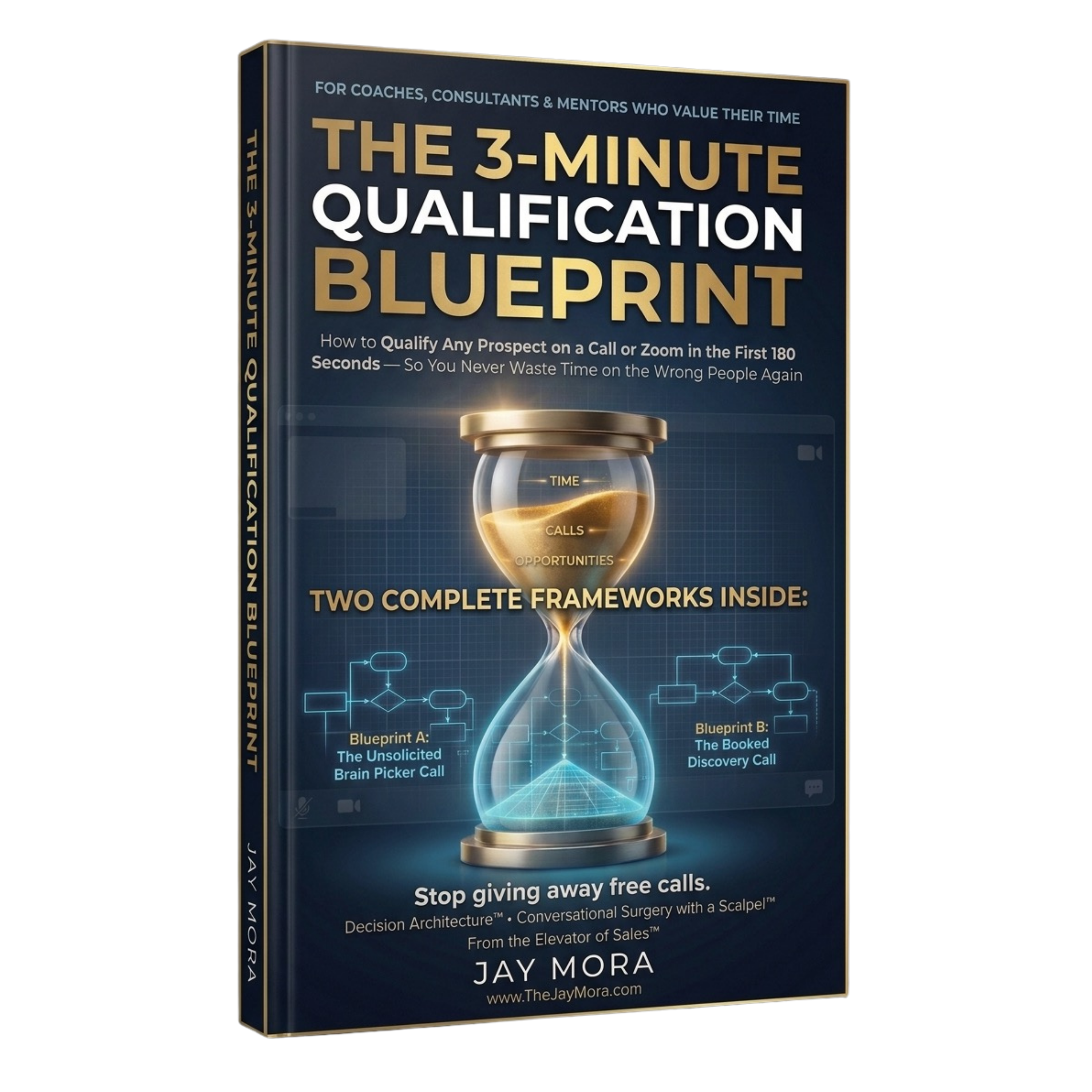
The calculator at thejaymora.com/calculator does this arithmetic for your specific numbers in sixty seconds. Put in your close rate, your average investment level, and your monthly call volume. The number that appears is what the mishandled objections have been costing you per year. Most coaches who run it sit with the result for a moment before doing anything else. It sends you a guide I wrote called the 3-Minute Qualification Blueprint as a gift for taking the initiative of running your numbers. The blueprint is your first line of defense against unqualified brain-pickers, protecting your hard-earned time and expertise. It might also land you that next client too.
Three Objection Handling Moves for Your Next High-Ticket Discovery Call
Three moves. Immediately executable on your next call. With the exact language.
Move One: Stop Accepting the Stall
When “I need to think about it” arrives, do not soften up, do not offer to follow up, do not ask if they have any other questions. Say this, with warmth and a smile.
“You’re not allowed to think about it… I only make this offer once.”
Then:
“I say that with love. But most of the time when I hear that, or when I’ve said it myself, it just means no. Is that where we’re at? Is it over?”
Let them respond. The real conversation begins the moment you refuse to accept the script.
If they confirm it is over, take it away from them entirely.
“You know what. Now that it’s over. What are you going to do about this?”
Then recap their needs, greeds, pains, and desires using their exact words. Re-enter the conversation from the emotional truth rather than from the beginning. When a prospect hears their own situation reflected back after they tried to leave, they almost always re-engage.
Here is the rule:
“It is only over when you say it is over. Not them.”
Move Two: Never Accept the Money Objection at Face Value
When “it’s too expensive” arrives, open by validating the reality of the number before defending the value.
“It is a significant amount of money. I’m glad you brought that up.”
Let that simmer. Then:
“Money aside. Forget about the money for a moment. Do you feel like us working together could actually get you to where you want to be?”
When they confirm, use the negative redirection:
“Let’s say, just for a second, that this was completely free. You still wouldn’t do this, would you?”
They push back. Of course they would. You have just confirmed that desire is not the problem. The only barrier is the logistics of the investment.
“I never change my price. But I can sometimes be flexible on how you get there. Tell you what, I’ve made a decision. I’d love to work with you. Imagine for a moment that I was crazy enough to make an exception. One that would allow you to put a fair and reasonable down payment, structure the rest into monthly payments or installments. That wouldn’t move the needle or help you in any way, would it?”
Then pivot into your financing method of choice only if it really is about the money.
Move Three: Let the Competition Sell You
When “I’m comparing you to others” arrives, praise the competition without hesitation.
While every other coach gets defensive, starts talking faster, and tries to convince the prospect why they are better, you do the opposite. You agree with them. Completely. And that agreement is what changes everything.
Respond by saying:
“Those are great people. Amazing reputations. Seriously. You must have signed up with them already, right?”
Then stop talking.
The prospect initially came in with that objection to see how you would respond to it. By praising the competition with the right tonality, the prospect now has to explain why they did not go with them. Every word they say in response is their own articulation of why you are the right choice. Not your articulation. Theirs. And their own words carry more persuasive weight than anything you say.
When they finish, reflect it back:
“So what you’re telling me is that the reason you’re on this call and not theirs is [their exact words]. Is that accurate?”
They confirm. Close.
How to Handle All Eight High-Ticket Sales Objections
These three moves address three of the eight objections a high-ticket coach will encounter at the close.
The other five still exist. “I’ve been burned before.” “I need to talk to my spouse.” “Do you have a guarantee?” “Why should I pay when there’s free content online?” “Can you send me more information?”
Each one has a complete response sequence. Each one requires its own specific mechanics, its own delivery, and its own exact language. Each one is the difference between a close and a follow-up that never gets answered.
I am covering all five in upcoming editions of The Decision Leader.
Every week, I publish a complete framework for established coaches who close high-ticket offers and want to stop losing deals they should have won. No summaries. No tips. Complete systems, built from inside the Elevator of Sales™, with real call demonstrations and exact language you can use the same day.
The burned-before recovery.
The spouse objection handled before it ever arrives.
The guarantee question turned into a close.
All of it is coming.
Subscribe to The Decision Leader below and you will receive each edition directly as it publishes.
The coaches who are serious about changing what happens at the close go find it.
The ones who are not ready yet keep ending Friday calls at 2:22 PM, following up on Monday to get a return of silence, and wondering what they did wrong.
Your next call is not going to wait for you to be ready. The system has to be built before you need it. Not after the stall arrives. Before.