The offer is in the room.
Your prospect has gone quiet. Not distant, not resistant. Quiet. Processing. The kind of quiet that opens when something real has just been said and the person hearing it is deciding what is actually true for them.
You know what this moment requires. You have studied it. Hold the silence. Six seconds. Maybe more. Let them arrive at the answer without interruption.
You last three.
You did not choose to speak. The words just came. A softened version of what you just placed in the room. An explanation that was not needed. And somewhere in the middle of the sentence you know: the call just moved.
That is not a knowledge problem.
That is the Execution Ceiling™.
You knew what the moment required. You had studied it. You did not choose to speak. The words just came. That is not a knowledge problem. That is the Execution Ceiling.
What the Execution Ceiling Is
The Execution Ceiling is not the limit of your knowledge. It is the limit of what your body can do automatically, under real pressure, when the stakes are real and the outcome is uncertain.
Knowledge and execution are not the same skill. They are not built the same way. The coaching and consulting industry has spent years teaching one while calling it both.
Knowledge lives in your mind. You build it through reading, watching, and studying. It accumulates fast. It recalls cleanly when there is nothing on the line. You can walk someone through a framework in a zero-pressure room and it lands exactly as designed.
Execution lives in your body. It is built one way only: repetition under real conditions with real resistance. It cannot be absorbed by watching a breakdown. It cannot be installed through understanding. It does not carry over from knowing it to doing it.
These build differently.
When a qualified prospect is in the conversation and real money and real hesitation are in the room, your body does not reach for what your mind knows. It reaches for what it has done before. Under pressure. Enough times that the response became automatic.
If that has not been built, it is not there when you need it.
That is the Execution Ceiling.
Your body does not reach for what your mind knows under pressure. It reaches for what it has done before, under pressure, enough times that the response became automatic.
The Moment It Shows Up
You have seen this in yourself in a specific way.
The prospect is engaged. The conversation is real. You have been asking the right questions and they have been going somewhere honest. The diagnosis is clear. You know this person has a real problem and you can solve it. The conversation is building toward the natural next step.
And then something shifts. Not in them. In you.
A half-second of hesitation. A sentence that did not need to be there. A silence that should have held for six more seconds but you filled it at three because the space felt too heavy and your body defaulted to relief instead of discipline.
The call that was open, now closes.
And that part stings. You knew it as it happened. Not after. During. You may have watched yourself do the wrong thing while another part of you stood slightly to the side, already assigning the verdict.
That is not ignorance. That is the Execution Ceiling in the room with you, measuring the exact distance between what you understand and what your body will execute when the moment costs something real.
Why Understanding Feels Like Readiness
This is why the ceiling stays invisible for so long.
When a framework clicks, when you study a concept and the logic settles into place, something happens that feels exactly like picking up a new skill. You can walk through exactly how it works. You can explain it. You can walk someone else through it step by step. You understand it fully and it feels like completion.
It is not completion. It is the starting line of a different, slower kind of work.
In a low-stakes environment, with your nervous system calm and the outcome at a distance, the framework performs exactly as studied. You understand it and you can use it.
On a live call, with a qualified prospect and a real number in the conversation, your nervous system is not calm. The outcome is not distant. The pressure is real. And in that state, your body does not go to what you know. It defaults to its training.
Understanding is not preparation for that moment. It is what has to happen before the real work begins.
There is a layer of work that comes after understanding. Most sales training stops before it starts.
Understanding is not preparation for a high-ticket sales conversation. It is what has to happen before the real work begins. There is a layer of work that comes after understanding, and most sales training stops before it starts.
The Conviction Pause. Three Seconds. Gone.
A consultant with ten years of documented results. A qualified prospect forty minutes into an honest conversation. The vision has landed. The offer is in the room. The prospect is quiet.
The Conviction Pause™ is what the moment requires. Silence. Uninterrupted space for the prospect to process what is actually true for them. Not as a tactic. As a form of respect for the weight of what was just said.
The consultant knows this. They have studied it. They believe it.
At three seconds, they speak.
It was not because they forgot. It was because their body has not been trained to hold that specific kind of silence under that specific kind of pressure. The discomfort is physical. The pull to fill the space is a nervous system event, not a decision. No amount of studying removes that pull.
The only thing that removes it is holding the silence in real scenarios, with real pressure, enough times that the body stops fighting it. Until it learns: this is what we do here. Hold.
That is body memory. That is what the Execution Ceiling sits just above.
The pull to fill the space is a nervous system event, not a decision. No amount of studying removes that pull.
The Foundation Isn’t the Finish Line
Study the frameworks. Understand the psychology deeply. Know why every move in a high-ticket conversation works the way it works.
That knowledge is not optional. It is the foundation that body memory gets built on. Without it, there is nothing to train.
But knowledge is not the finish line. It is the starting line.
The coaches and consultants who close consistently at high-ticket levels are not the ones who know the most. They are the ones who have built body memory for the specific moments that determine the outcome.
The pause after the vision. The silence after the offer. The redirect when the prospect reaches for an exit. The steady voice when the number is in the room.
They have been in those moments enough times, under enough real pressure, that the execution is no longer a decision. The body moves. The mind observes.
That is what separates the coaches and consultants who are always preparing from the ones who have already prepared.
The coaches and consultants who close consistently at high-ticket levels are not the ones who know the most. They are the ones who have built body memory for the specific moments that determine the outcome.
Before You Dial. Three Things.
These are not principles. They are instructions.
1. Find the one moment where you break.
You do not have a problem with your entire call. You have a problem at one specific moment. That is where your Execution Ceiling is.
Name it precisely. Is it the silence after you deliver your offer? The first time the prospect pushes back on the investment? The transition from diagnosis into vision? The moment the real number enters the room?
Every drill you run from this point forward needs to be built around that one moment. Not a full call replay. That specific moment, with real enough resistance that it triggers the same pull you feel in a live scenario. You drill it until the body stops defaulting to the wrong response. Not until you understand why the right response works. Until the body just does it.
2. Review the thirty seconds around the breakdown on your recorded calls.
Not the whole call. The window where the direction changed.
You are not listening for what you said. You are listening for what almost happened and did not. The half-beat before you filled the silence. The word that arrived when you meant to stay quiet. The explanation that came out when the prospect had already accepted.
That thirty-second window is the most honest feedback you have in your business. It tells you exactly what your body defaulted to when the stakes were real and the training was called on. That is the specific thing you are retraining.
3. Build a physical routine before every high-stakes call. Not just a mental one.
Most coaches and consultants prepare by reviewing notes, the prospect’s background, and their framework. That is mental preparation. It is useful. It is not sufficient.
Add three minutes of physical preparation before every call that matters. Not visualization of the content. Getting your body right. Breathing. Grounding. Presence.
One question asked and answered before you dial: who is this specific person, and what do they most need from this conversation?
Your body’s state when the call starts determines how much of your actual training is accessible during it. A distracted or wound-up nervous system narrows your reach. Calm it deliberately, before every high-stakes call, as a non-negotiable.
Your body’s state when the call starts determines how much of your actual training is accessible during it.
Run the Number.
One qualified prospect. Forty-five minutes of real engagement. A real investment amount in the room. They do not move forward.
At $15,000, that is $15,000 that was present and left.
If you are closing three of every ten qualified conversations right now, and the Execution Ceiling is why it is not five, the difference is two additional closes per ten calls.
That is $30,000 per ten conversations.
Run that across a quarter. Run it across a year.
That gap is not your offer.
That gap is not your funnel.
That gap is not your pricing.
That gap is not even your positioning.
It is the distance between what you know and what your body executes when the pressure is real and the outcome is not yet decided.
That distance has a number. Most people have never calculated theirs.
That gap is not your offer. That gap is not your funnel. That gap is not your pricing. That gap is not even your positioning. It is the distance between what you know and what your body executes when the pressure is real and the outcome is not yet decided.
The Call Is Still in the Room
The offer is still in the room. You heard yourself speak first. And part of you already knows exactly why.
You do not lack the knowledge.
You have not yet built the second layer of the skill.
The Execution Ceiling does not mean you are not capable. It means you have done the first kind of work and not yet the second.
Knowledge is the first layer.
Body memory is the second.
Most training delivers one and calls the job complete.
The job is not complete.
The coaches and consultants who break through the Execution Ceiling are not the ones who found better frameworks. They are the ones who identified the specific moment where their training stopped working and drilled that exact moment until the body knew what to do without being asked.
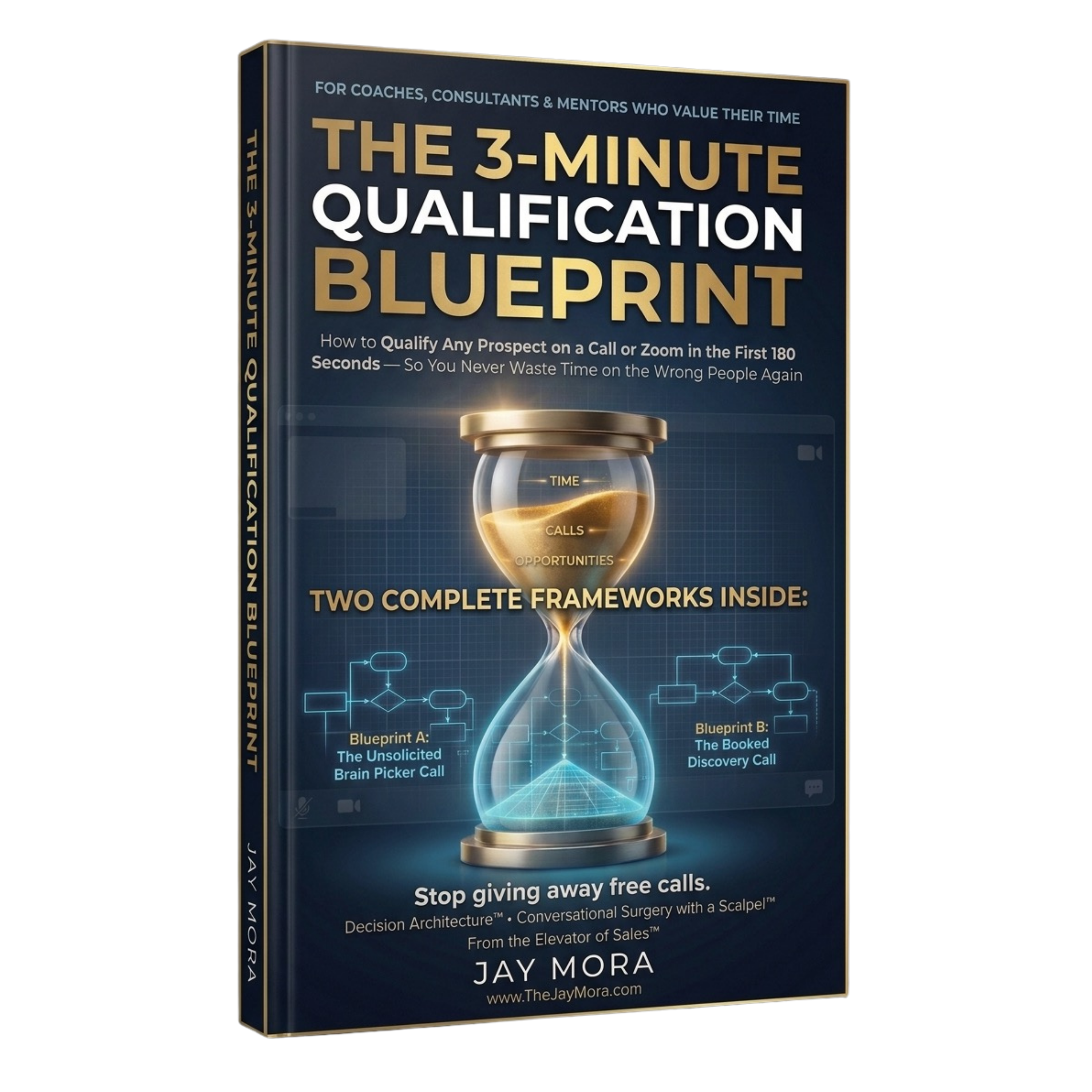
If you want to know what your Execution Ceiling is costing you in real numbers, the Revenue Leak Calculator at thejaymora.com/calculator gives you the number in 90 seconds and delivers the 3-Minute Qualification Blueprint™ so you leave with both the diagnosis and a clear place to start.
If the number is significant, the conversation about what to do with it is worth having.
If it is not, keep reading essays like this one.
One of those is a decision. The other is a pattern.

If the problem this essay describes is the one you are carrying into every call, the next step is a conversation.
Apply for the Discovery Call Diagnostic →